Powder or granular form
State the required particle form, size distribution, and feeding characteristics. Available forms must be confirmed for the chosen source.
Sebacic acid is a castor oil derived dicarboxylic acid used in polymers, plasticizers, lubricants, and corrosion-control applications.
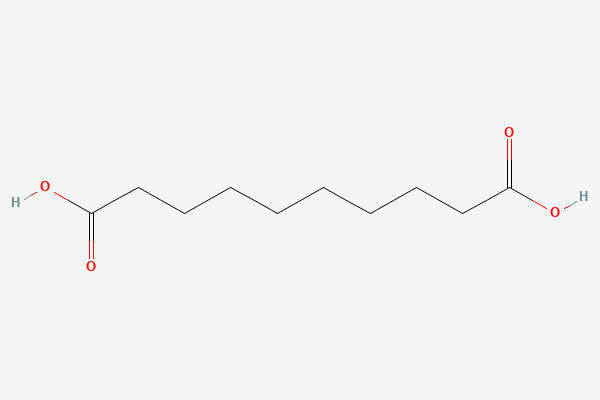
Sebacic acid, also called decanedioic acid, contains a ten-carbon chain with a carboxylic acid group at each end. Chemstock describes it as a castor oil derived intermediate used in polymers, ester plasticizers, lubricants, and corrosion-control applications.
Substance reference values, separate from the supplied-grade specification. Conditions and source are shown so your technical team can interpret the data.
| Property | Reference value | Conditions / source |
|---|---|---|
| Physical state | Solid | At 20 °C. [2] |
| Reference melting point | 134 °C | Substance reference, not a guaranteed supplied-grade limit. [2] |
| Boiling point | 295 °C | At 100 mmHg; this is a reduced-pressure value. [2] |
| Water solubility | 1 g/L | At 20 °C. Source-specific reference value. [2] |
Typical limits from Chemstock’s existing catalogue. Final limits, test methods, particle form, and packaging must match the current supplier specification for your order.
| Parameter | Published limit / value | Method / conditions |
|---|---|---|
| Appearance | White powder | Visual description |
| Purity | 99.5% min. | Confirm analytical method |
| Water content | 0.3% max. | Confirm test method |
| Color, APHA | 50 max. | 4% solution in ethanol |
| Acid number | 550 mg KOH/g min. | Confirm titration method |
| Melting range | 130–134 °C | Confirm method and acceptance range |
| Ash content | 400 ppm max. | Confirm method |
Request the grade-specific technical sheet, analytical methods, and a representative CoA. Batch results belong on the shipment’s certificate of analysis.
Request a technical packageState the required particle form, size distribution, and feeding characteristics. Available forms must be confirmed for the chosen source.
Define your color test conditions and titration method so results can be compared with your incoming specification.
Request source-specific origin or renewable-feedstock evidence. Castor-derived chemistry alone does not establish a certified sustainability claim.
Intermediate for polymer production and sebacate ester plasticizers.
Used in lubricant-related chemistry and corrosion-control applications.
Used in chemistry serving coating and cosmetic applications.
Product documents are available on request. Tell us the required grade and destination so we can identify the right documentation for your review.
Current safety, handling, transport, and disposal information for the grade and destination.
Include: Required grade, destination country, and preferred language.Request SDSCurrent acceptance limits, physical properties, and the relevant analytical methods.
Include: Your internal specification and required test methods.Request TDS / specificationBatch-specific results for a supplied lot, or a representative CoA for qualification.
Include: Lot / batch number for an existing shipment; otherwise request a representative CoA.Request CoASource-specific certification and supporting information for your qualification process.
Include: Required certification, manufacturing site scope, and validity requirements.Request Supplier documentationCertificates apply to a named source, site, grade, or batch. Request the scope and current revision needed for your approval process.
Discuss the source, commercial requirements, and delivery schedule before placing an order.
Share your qualification questionnaire, incoming specification, required documentation, and change-notification expectations with our team.
Discuss supplier qualificationThis overview supports initial review and does not replace a current SDS, site risk assessment, or grade-specific handling instructions.
A reference manufacturer identifies skin and eye irritation hazards. Review the SDS for the supplied grade and control exposure to dust. Reference [2]
Request the manufacturer’s recommended storage temperature, moisture controls, shelf life, and retest period. Storage conditions should follow the supplied grade’s documentation.
Confirm classification for the supplied material, packaging, transport mode, and destination using the current SDS. No shipping classification is asserted for a specific Chemstock supply here.
Applicable requirements depend on the source, destination, and end use. Use this list to identify the statements and evidence your team needs; it is not a claim of certification or regulatory approval.
They share the chemical identity, but particle form can affect handling and processing. Specify the required form and validate it in your application; do not assume a source change is equivalent.
Chemstock’s published description identifies castor oil as the feedstock. Certification or a quantified bio-based claim must be supported by documentation for the actual source and grade; request that evidence if your approval process requires it.
Begin with purity, water, acid number, color under defined test conditions, melting range, and ash. Add any particle-size or trace-impurity requirements specific to your process.
Reference data checked September 22, 2026. Public references describe the substance; only the current supplier documents establish the specification, certifications, and shipment details for the material you purchase.
Chemical identity, molecular weight, and structure.
General physical-property and hazard reference only; not a Chemstock grade or supply specification.
Cross-reference for EC identifier.
Existing typical specifications and applications.